
How it works
Weighing food: raw or cooked?
Rice roughly triples in weight when cooked and chicken loses about a quarter. Which weight to log, how to convert, and how to portion a batch accurately.
Why the weight changes
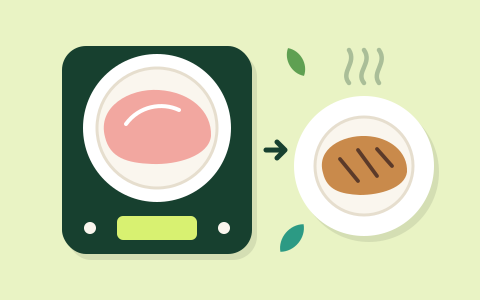
Cooking moves water. Dry foods absorb it: boiled long-grain white rice ends up at about three times its raw weight, brown rice at about 2.6 times and dried pasta at a little over double. Meat loses water, along with some fat, so the same piece weighs less afterwards while its protein is unchanged.
USDA cooking-yield tables give the scale. Roasted chicken breast keeps about 72% of its raw weight, and simmered about 77%. Grilled sirloin steak keeps about 80%. Minced beef keeps between 62% and 77%, depending on its fat content and whether it is fried loose or cooked as a patty.
Which weight to log
Either works, as long as the weight and the database entry match. “Rice, raw” weighed raw and “rice, cooked” weighed cooked give the same answer; mixing them does not. Per 100 g, the USDA lists raw white rice at 365 kcal and cooked at 130 kcal, so logging cooked rice as raw nearly triples the calories.
Raw is the more repeatable choice, because cooked weight depends on how long the food was cooked and how much water it took up or lost. Weigh meat raw and out of its packaging, and rice, pasta and oats dry. Recipes on this site should list ingredients the way they are measured, and the working is shown on every recipe page.
When you only have the cooked weight
For a batch, weigh the raw ingredients as they go in, then weigh the finished dish and divide by the number of servings. Each portion is then a known share of the total, whatever the water did during cooking. It works for any dish cooked in bulk.
For a single cooked portion with no raw weight, convert with a rough factor: divide cooked chicken breast by about 0.75, cooked white rice by about 2.8–3 and cooked pasta by about 2.1–2.4 to estimate the raw weight. These are averages. Your pan, timing and brand will differ, so treat the result as an estimate.
Worth knowing
- Yield figures are averages from test kitchens and laboratories. A well-done steak or pasta cooked very soft will sit outside them.
- For bone-in cuts, weigh the bones afterwards and subtract them, or use a bone-in database entry.
- A consistent method matters more than a perfect one. Judge progress on a trend, not on one day’s numbers.
Common questions
Should I weigh chicken raw or cooked?
Raw is more consistent. If you can only weigh it cooked, use a cooked database entry, or divide the cooked weight by about 0.75 to estimate the raw weight.
Why does my cooked rice weigh three times as much?
It has absorbed water, which has no calories. 100 g of dry white rice becomes roughly 280–300 g cooked, with the same calories and carbs as before.
Do the macros change when food is cooked?
Not by much. Water moves in or out and some fat can render out of meat, but protein and carbohydrate stay close to the raw totals. What changes is the amount per 100 g.
Sources
General information, not medical or dietary advice. Speak to a doctor or registered dietitian about your own situation.


