
How it works
Alcohol and your macros
Alcohol has 7 kcal per gram and is not protein, carbohydrate or fat. How drinks are counted, what common ones contain, and what health bodies advise.
Where the calories come from
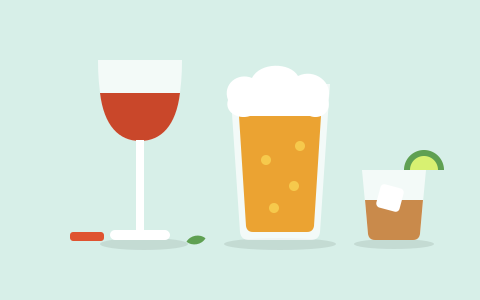
Pure alcohol provides 7 kcal per gram, almost as much as fat at 9 and well above protein and carbohydrate at 4. A UK unit is 8 g of alcohol, about 56 kcal. A US standard drink is 14 g, about 98 kcal. Beer, cider, sweet wine, liqueurs and mixers add calories from sugar on top.
NHS figures put a pint of 5% beer at up to 222 kcal, a 175 ml glass of 12% wine at up to 158 kcal and a 50 ml glass of 17% cream liqueur at 153 kcal. A US standard measure of 40% spirits, 1.5 fl oz or about 44 ml, holds 14 g of alcohol, so about 98 kcal before any mixer.
How to count a drink
Alcohol is a fourth source of energy, so a drink’s calories are higher than its protein, carbs and fat would explain. A neat spirit has no carbohydrate to speak of and still carries all of its alcohol calories. The simplest method is to log the calories and accept that the three macros will not add up to them.
If your tracker only handles three macros and you want the totals to balance, convert the alcohol calories instead: divide by 4 to log them as carbohydrate, by 9 to log them as fat, or split them between the two. This is a bookkeeping convention, not physiology. Your protein target is unaffected either way.
What health bodies say
The UK guidance, as given by the NHS, is that to keep health risks low, men and women should not regularly drink more than 14 units a week, spread across three or more days. The US CDC describes moderate drinking as two drinks or less in a day for men and one or less for women, and adds that drinking less is better for health than drinking more.
Neither figure is a target. Some people should not drink at all, including during pregnancy, when taking medicines that interact with alcohol, and with certain medical conditions. Nothing in this guide is a reason to start drinking or to drink more; it only explains how the numbers work if you do.
Worth knowing
- This guide is for adults of legal drinking age.
- Calorie figures for drinks are averages. Strength and serving size vary, so check the label for the ABV and the measure.
- If you are worried about your drinking, speak to your doctor or a local alcohol support service.
Common questions
How do I work out the alcohol calories in a drink?
UK units are ABV × millilitres ÷ 1,000. Each unit is 8 g of alcohol, about 56 kcal. Add the calories from any sugar in the drink or the mixer.
Does alcohol count as a carb?
No. It is a separate source of energy at 7 kcal per gram. Some trackers log it as carbohydrate or fat so the totals balance, but that is a convention.
Sources
General information, not medical or dietary advice. Speak to a doctor or registered dietitian about your own situation.